
An Office with a View
Daniel Treier's Promotion to Glory

“Life is short,” they say. And we all know that time races on. But at 48, I’m learning that things can change in an instant.
My alma mater, Multnomah University, was buried this year, along with three of our beloved Multnomah professors. Karl Kutz died at 62 after a battle with cancer. Tim Aldrich died at 82. And this past weekend Ray Lubeck died (age 71) because his heart finally gave out 40+ years after cancer treatments damaged it. Both Karl and Ray made the trek all the way from Oregon to Colorado for our wedding. I worked closely with both of them, grading papers, teaching classes, and learning all I could. To lose both in the same year is devastating. I was already weeping my way through the day yesterday over this most recent loss when I received the news that another academic mentor was in his final hours. He died last night.
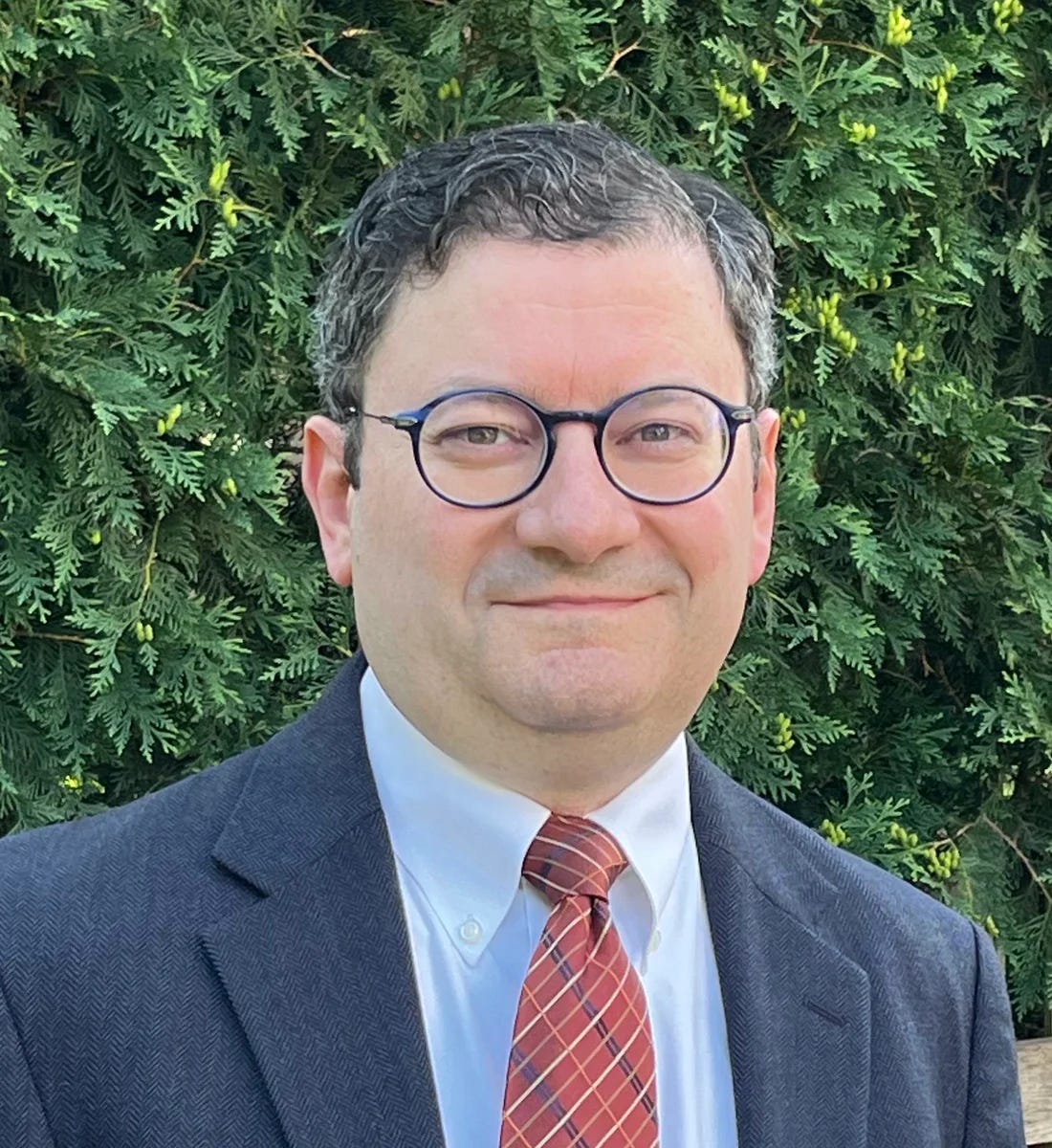
Daniel Treier was a young PhD mentor at Wheaton College and I was an old PhD student, so he has just 5 years on me. (For the record, 53 is far too young to die.) As far as I know, Daniel Treier was fine two months ago, other than a persistent cough and strange headaches. Within weeks of his diagnosis with (non-smoking) lung cancer, his body began shutting down, with a heart attack and string of strokes brought on by the cancer that had spread to his brain.
Dr. Treier earned his PhD under Dr. Kevin Vanhoozer at Trinity Evangelical Divinity School, another campus that announced its closure this year. (It’s moving to Langley, BC to merge with Trinity Western University, but most of the faculty have lost their jobs.) Dr. Vanhoozer was rehired at Wheaton College, where he would have had the joy of working side-by-side with Dan Treier again (he was there for a brief stint while I was in the PhD program). So the death of an alma mater coincides with the death of one of its star graduates.
I mailed Dan a Christmas card on Saturday that he will never read. I sensed that the prognosis was not good, but was hoping that we’d have more time with him. He leaves behind his wife, Amy Black, a professor of political science at Wheaton, and their daughter, Anna, a current student at Wheaton. He also leaves behind thirteen doctoral graduates and six more who were partway through their doctoral studies.
Remembering Dan Treier
Dr. Treier was my first professor in the PhD program at Wheaton. He guided our cohort through our first semester, helping us navigate what was expected of us in a very demanding program. He forced us to use our newly-acquired theological German and gave us straight-talk about the dissertation process. His advice fit his clear-eyed (if a bit pessimistic) view of life: don’t expect things to be easy, and above all don’t expect fanfare. Just get your work done. He prepared us for a world in which no one would read our dissertation and it wouldn’t change anyone’s mind and we might not get a teaching job.
When Wheaton renovated the 5th floor of the Billy Graham Center as a new home for Bible and Theology faculty, Dan’s assessment sounded just like Eeyore: “Well, it looks like I’ll be spending the rest of my career in a windowless office.”
Although he was not my doctoral advisor, we interacted quite a bit, in part thanks to Wheaton’s “Dine with a Mind” program, where grad students could pick up free lunch tickets to take a prof to lunch in the Cafeteria. Over one meal, Dan gave me “doctrinal counseling,” as I sorted through my ecclesial past and tried to find coherence. Over another, he offered deep encouragement following an especially challenging year.
In the years since we moved away from Wheaton, I’ve been so grateful to connect with Dan at the annual meeting of the Evangelical Theological Society. About two years ago I was on campus at Biola and rounded a corner, surprised to see Dan and Amy. They were touring Biola with their daughter Anna (who ultimately decided to stay closer to home). Dan was kind enough to endorse my latest book, Becoming God’s Family, which came out just before his diagnosis.
I’ll remember Dan for his wry humor and sober assessment of the state of things. The day I defended my dissertation he said, “Carmen, don’t let grass grow on this. Get it published.” His advice proved valuable, as my dissertation came out the following year. He was careful about what he agreed to do. I recall him saying that he tried to publish one book review a year “as a matter of academic citizenship,” but no more, because it would distract him from producing his own scholarship.
I’m stunned that we’ve lost him so soon. He and Amy navigated this challenging month since his diagnosis with such faith, hope, and humor. Dan was ready for his upgrade to an office with a view. He was ready to meet the Savior he wrote about so eloquently.
Dr. Treier’s Legacy
If I could sum him up in one word (which of course I can’t), I would chose WISE. Wisdom was his aim and, and he hit the target over and over again. It was not unusual to ask Dr. Treier a question and receive a three-part verbal response, logically organized and worth framing. He was humble and kind. His twinkle and his laugh are unforgettable. I already miss him so much.
Dan’s legacy will live on in the doctoral students he mentored. He was the primary supervisor for thirteen who successfully defended their dissertations: Uche Anizor (2011), Steve Pardue (2011), Hank Voss (2013), Chris Atwood (2014), Stephanie Lowery (2015), Robbie Crouse (2016), Craig Hefner (2018), Ty Kieser (2020), Chris Smith (2021), Jeremy Mann (2021), Gerardo Corpeño (2022), Dustyn Keepers (2022), and Euntaek David Shin (2022). Six more of his doctoral students are still in the program at Wheaton. Dozens more had him as a second reader or as the chair of their defense. His fingerprints are on the work of scores of emerging evangelical theologians.
A World Without Dan?
It’s Christmas week, which means that countless households are watching the classic, It’s a Wonderful Life! George Bailey wishes he had never been born, and he gets his wish. He encounters a world without his wholesome, life-giving influence on his community. What he finds is truly frightening.
The rest of us don’t get to see what life would be like without us, or without Dan Treier. We wouldn’t want to. The world we have is the one with him in it. His steady wisdom and patient investment has reshaped the landscape of evangelical scholarship, and because of that, it has brought streams of living water to the church. Dan’s first doctoral student, Uche Anizor, wrote the Christianity Today Book of the Year in 2022, entitled Overcoming Apathy: Gospel Hope for Those Who Struggle to Care. I offer two more examples I’ve been able to see up close:
One of Dan’s first doctoral students, Hank Voss, was recently appointed to an endowed chair at Taylor University, where he has been teaching theology for half a decade, following his lengthy service with The Urban Ministry Institute. In response to Hank’s vision to resource inner city pastors and those working in prisons, who often have little to no formal theological education, the Lilly Foundation has awarded Hank over $1.5 million to date. With that money he founded the Sacred Roots Thriving in Ministry initiative, which resources inner-city pastors with classics from Christian history to enrich their ministries. (Hank invited me to produce a volume on early Christian readings of the Psalms for this book series, which came out back in 2021.)
With Dan Treier as his supervisor, Hank wrote about the priesthood of all believers. Dan’s influence on Hank’s work will bear dividends for years to come in every congregation pastored by someone touched by Hank’s training and resourcing.
Hank wrote this about Dan, and gave me permission to share it here:
One of my favorite “Dan moments” was our first official meeting back in 2009 after I arrived at Wheaton as his doctoral student. I was not sure what to expect but soon learned how incredibly generous Dan would be as a PhD supervisor with his time. I had heard many horror stories of how difficult it can be for a PhD student to schedule regular time with their mentor. In our first meeting, Dan asked me, “Do you want to meet for 30 minutes or an hour every week?” Of course I said, “let’s meet for an hour.”
During the next four years, Dan mentored me in ways that will impact me for the rest of my life. If limited to one hand, and asked to name the five most influential people in my life, Dan would be one. In his life, I saw the faithfulness of Christ especially in his intellectual integrity and rigorous pursuit of truth, truth always spoken in the context of love. As Dan’s student, I never doubted he loved me and wanted me to succeed. But he still made me turn in more than ten drafts of my dissertation proposal before he was satisfied with its intellectual rigor.
Lately, I have been praying daily using St. Meinrad’s Liturgy of the Hours for Benedictine Oblates. Yesterday’s prayer included this line: “Lord we ask that the hope of heaven make us bold in doing the will of God here on earth.” Dan’s life modeled for me both this hope and this boldness. Dan, may we follow your example and finish well as you have done. Thank you for showing me how to live well, and now how to die well. You will be missed.
Steve Pardue is another example of Dan’s global influence. Steve lives and works with his family in the Philippines, where he supervises graduate theological education for leaders from across southeast Asia with the International Graduate School of Leadership. He is facilitating theological formation for a generation of scholars who will shape the future of the church in Asia, helping them think well and publish their work for the broader church.
One of Steve’s first published projects was a multi-year initiative with Gene Green and K.K. Yeo in conjunction with the Evangelical Theological Society, where he invited global scholars to present contextualized work in theology. You can benefit from their multi-year project because it was later published as Majority World Theology.
Steve writes of Dan,
Aside from his brilliance—which was obvious even to all of us, freshman and sophomores in college—Dan embodied Christlike wisdom and spiritual vibrancy. He prayed patiently and extensively with us at the start of each class time, and the way he prayed genuinely reflected the theology we were learning together. And he was shockingly generous with his time, recognizing that transformative teaching often requires going the extra mile and extra hours.
Over the years, I got to experience this potent mixture—intellectual rigor, spiritual vitality, and Christlike wisdom—again and again. When the opportunity arose to have him as a PhD mentor, I didn’t have to think twice. In those 4 years of working closely together, there was zero disillusionment; his character was such that my admiration for him only grew as I got to see into his life more closely. He was legendary for his incredibly wise and shockingly rapid feedback on anything we submitted to him.
In the 14 years since I finished my dissertation, one of my greatest joys and encouragements has been getting to know Dan as a friend. He was always still a mentor to me—a Gandalf who always had wise counsel and saw things at a different level than I did—but also became one of my most cherished companions through the ups and downs of life.
Dan’s Office with a View
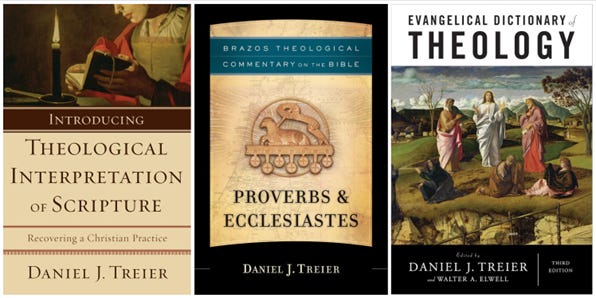
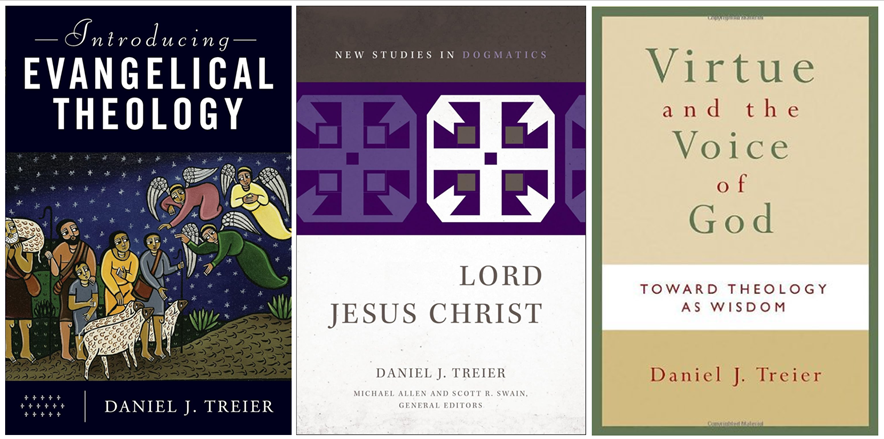
My point is that if we want to understand Dan Treier’s influence, we’d have to follow his doctoral students around the world where they are shaping a whole generation of scholarship. I suspect that once Dan makes the rounds to greet the other saints in glory, he’ll get right to work in his new “office-with-a-view” on a revision of his Introduction to Evangelical Theology. Knowing that “we see through a glass darkly” here on earth, I expect he’ll want to address anything he didn’t get quite right, now that he can see his glorious Lord face to face.
When he told me not to “let grass grow” on my dissertation, it wasn’t because he thought I’d made a definitive contribution to theology. His charge to get busy with good work suffered from no illusions about the possibility of perfection or even the hope of a positive reception. He knew we must be faithful to do what we can while we can because none of us is guaranteed a long life. We cannot waste these fleeting years paralyzed by perfectionism. Too much is at stake.
I’m glad he took his own advice so seriously. A colleague and I invited him to contribute to a project two years ago. The essays are due next week. Obviously, if he had waited until the last minute, we’d have lacked his voice in the project. But Dan turned in his essay eighteen months ago. I can’t share more about that project now, but in good time, his work will see the light of day thanks to his dedication to the project. He knew how to get things done, and I’m so grateful.
We mourn his loss, but we also carry on the good work he started with deep gratitude for the life he lived.
Thank you for this. You helped put words to some of what I've been feeling. I knew Dr. Treier as an undergrad student at Wheaton many years ago. I remember walking out of his systematic theology class completely overwhelmed by the intellectual rigor––and at the same time enthralled by the God I was quickly learned was so much bigger than I'd ever imagined before. Tears well up in my eyes as I type now. Some of his writing is on my shelves currently and is continuing to shape and form me. What a privilege to learn from him.
Twenty years ago, I'd thought I'd been nearly failing systematic theology at one point because it was so stretching for me. Then I found out Dr. Treier had mentioned my name to another prof about being a T.A. for her. I couldn't believe it, and I found that to be the greatest compliment I could have asked for. Both rigor and kindness ran deep in this man.
Wow. Two influential Christian scholars in the space of a week. Even though I never met either, I'm grateful for their love for Christ and their love for students. And I'm thankful for their influence on you and your scholarship.