
Learning Relinquishment
On Parenting a Parent with Dementia

It seems like last week that I dropped off my 2-year-old son, Easton, at preschool. He’ll be 18 next week. I remember my acute concern that his teachers would not be able to understand Easton’s unique communication system of grunts, gestures, and half-pronounced words. Easton was a bright kid. His comprehension and communication were spot on, but unconventional. He had only a handful of English words, but he was skilled at letting us know just what he wanted using his version of “Cave Man”—a language in which all of us in the family were fluent.
I presented his teachers with a printed glossary of Easton-isms to help them get started. He was our youngest, our caboose. I imagined this transition marked the beginning of the end of my parenting journey.
I was wrong. No one told me then that I would go through this experience again with my father. Handing over all his meds to the nursing director at his assisted living facility on Saturday felt like a relay race in pitch dark. I could not see the faces of those who would take this baton. I could not tell if their grip was strong enough. I thought we should talk longer. I wanted them to know him better first.
Don’t you want to know Dad’s schedule? Don’t you want to see how I’ve organized his closet? Can’t we meet all the caregivers? Aren’t you going to talk with him about how his life is about to change?
I handed Dad his new keys, but I wanted to give his caregivers some kind of key too—one that would unlock his brain so that they could understand one another. I can generally figure out which friend Dad is referring to, even when their name escapes him. I know that “Oppenheimer” is really “Bonaventure” (both four syllables), and by process of elimination I can work out what is bothering him—even when its based in a hallucination.

When the plane lifted off that afternoon to take me home, the gap in his care had not yet been closed. The phone jack still wasn’t working in his new apartment. And I kept thinking of all the things I didn’t yet know:
How will I let them know when Dad has a doctor’s appointment? Did he agree to wear the call button? Will he remember his keys? Will he be able to find his handkerchiefs? Will he use the soap I put in the shower? Will they help him with laundry if he wets the bed? Will they remind him to get on the shuttle for church tomorrow? Will he be able to figure out the way to his friends’ rooms from this new starting point?
Letting go of Dad feels exactly like letting go of Easton, not knowing if I can trust others to love and serve him well.
Will they lose patience or make him feel dumb? Will they be gentle? Will they make a good connection? Will they push him to do something he doesn’t want to do? Will he accept the help he’s offered?
The Arc of Life
Life is an arc of abilities. If we live long enough, step by step we lose the abilities we once gained as a child. Distance vision. Comprehension. Vocabulary. Fine motor skills. Strength. Potty training. Balance. Mobility. Endurance. Emotional regulation.
On Friday morning, Dad and I stood at the door of his new bedroom. His dresser and bedside table were already in place. On the floor, pieces of cardboard marked where the bed would stand. He pointed to the space. “Is this my bed?” he asked.
“Yes, this is where the bed will be.”
His arm made a broad, sweeping motion as he spoke. “It doesn’t seem very . . . substantial,” he said, a hint of concern in his voice.
The night before, it had been his idea to lay out cardboard to represent each piece of furniture. But the upheaval of moving had taxed him to the point that he was no longer capable of abstract thinking. I reassured him, “That’s because the bed isn’t here yet. The guys are bringing it up right now.” Poor Dad thought we were going to make him sleep on cardboard scraps. He was so relieved to hear otherwise.
I asked his buddy to take him downstairs for a snack to relieve his anxiety (and make our job a bit easier) until we could get the rest of the room set up. When he returned, to his delight, the bed was substantial indeed and all his important pictures hung just where they belonged on his walls—an aerial shot of Pitt Meadows, BC, where he grew up, several framed windmills from the Netherlands, two sunsets, one taken by him and one by me, an adorable shot of me and my brother reading a book in 1983, and three framed prints by Charles Peterson. He was amazed. It already felt like home.
Letting go of the old place is easier when you have a place to land.
Growth and Decline
The human life is bookended by growth and decline. Eighteen months ago, my Dad gave up his keys the same month that Easton took his drivers’ test.
Nine months ago, just as we hired caregivers to check on Dad every morning and give him his meds and help him make his bed, Easton moved into his college dorm with a box of toiletries and basic over-the-counter medicine in case he got sick. We relinquished our role of reminding him daily to brush his teeth and shower just about the time we began reminding Dad.
This month, Easton bought and built a new computer, while Dad relinquished his, which had been sitting dormant for the better part of a year. Machines are no longer his friends. Their sinister buttons and prompts are beyond his ability to navigate. Email is far too confusing. He reported a month ago that his old TV—a fine specimen —ended up in the bottom of the dumpster, replaced by a new model from Target that Dad hoped would work well. (In truth, we found the previous TV in his closet. Perhaps he dreamt that he disposed of it? Now it’s found a new home. My Dutch heart was relieved that it hadn’t gone to waste.)
Easton and I crossed paths in the kitchen yesterday as he put a frozen pizza in the oven for lunch. Dad’s new room has no oven, so his days of frozen pizza are over.
Of all the things we cleared out last week—Dad’s golf clubs and his files, business cards and cooking pans, his e-bike and racquetball racquets, patio furniture and fishing poles, tupperware and a pile of keys to who-knows-what (no one does)—a few things were more difficult to relinquish. Sliding his desk onto the van to take to the thrift store was tough for me. He’s had that desk as long as I’ve been alive (which, for anyone who’s counting, is nearly half a century).
Since it wasn’t practical to keep the desk, I held on to the Home Depot contractor pencils. For me, Home Depot will always smell like my Dad, just home from work. I would run to give him a big squeeze and bury my face in his sweaty shirt, smelling of sawdust and paint.
Dad’s tool bag still sits in his closet, too, just so he remembers who he is. I’m sure he no longer needs a crow bar, but he set it lovingly in the front closet next to his drill (which he no longer understands how to charge). He was glad to find he still had a hammer.
From here on out, Dad will relinquish his independence little by little, requiring more and more support with daily living. It’s the nature of dementia. For now, he can still climb stairs and go for walks outside alone. He manages to feed himself, even if it’s messy and his method is unconventional. But it’s only a matter of time before he’ll need assistance.
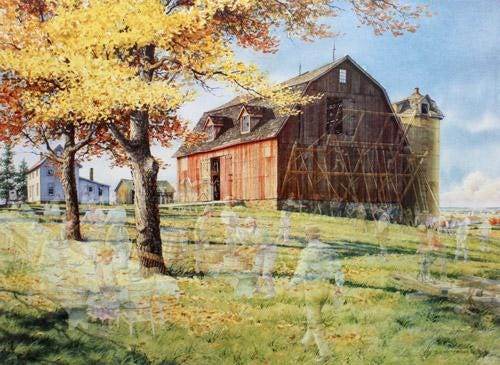
One thing we can hold on to is the memories. (Lewy Body Dementia affects executive functioning and eventually mobility more than it does memory). Dad’s walls are graced by several prints by Charles Peterson, a genius of an artist who figured out how to superimpose nostalgic memories on canvas. My favorite is the barn raising, which shows the old barn alongside the memory of raising it with the help of neighbors. While we didn’t raise a barn last week, dear friends pitched in to make the entire move in one day to minimize confusion for Dad.
He and I cleared out most of his books together the day before the move. He admits that reading is more difficult than it used to be. He kept the ones I’ve written. I doubt he’ll read them again at this point, but I suspect he’ll brag about me to his caregivers. His men’s group listened to the audiobook of Becoming God’s Family together last fall so that Dad wouldn’t miss out. Friends like these are worth more than gold.
I’ll be bragging about him, too, especially the way he’s so willingly let go of his past and embraced the present with gratitude. He says it will take some getting used to to have people in and out of his apartment checking on him all day long. As my husband and I gradually take responsibility for more and more of his life, I’m losing my father and gaining another son.
We all die eventually, and the path to get there is marked by letting go, little by little. The sooner we make peace with that, the easier it will be to see the gift of dependence. Just as a child bonds with his mother because he needs her to survive, so does a father bond with his daughter because he can’t get on without her.
I’m right smack in the middle, part of the so-called “sandwich generation,” discovering just how beautiful it is to need and to be needed, to let go and to embrace.
We cannot protect each other from these fraught stages of life without losing something vital about our humanity. To belong to one another is what makes life worth living.
Life is full of letting go. So true. You are bringing back memories of caring for my dad during his final years with Parkinson’s. Sending a big hug ❤️🩹
You sound like an amazing observant caring person. Serving. I was also an airplane ride away during this season. It is an exhausting experience. I was only 19 years younger than my mother, so towards the end lifting the walker over and over to give her an excursion started being a chore for my old body. Assisted living was a blessing. I visited many times and had no concerns about any sort of neglect. God provided her with girlfriends and they colored together every evening after dinner. I got. her one of the early robot puppies. It was so cute and would look at her when she moved. Wag its tail. Her girlfriends loved it. But she always wanted to be somewhere else. Her memories of how family looked, so different from our realities. We live in amazing times with airplanes and FaceTime and toy dogs. Thanks be to God.